Showing posts with label sketchbook. Show all posts

Sunday, 27 October 2013

27/10/13- Kanji Pictorial Origins

The idea of languages developing through abstraction of an image immediately made me think of the pictorial nature of Kanji characters, a writing system that has Chinese origins but was adopted into the modern Japanese writing system after being introduced to these characters over the years through coins, seals, weapons and decorative items imported from China. The specific origin of these symbols is still questioned to this day, and there isn't one official answer yet, however it is known that Kanji is the result of pictographs and the simplification of images, and the oldest kanji symbols have been found on animal bones and tortoise carapaces as inscriptions dating from around 1700BC-1100BC, during the Shan Dynasty. Of course, these characters have changed a lot over the centuries, and once they were adopted into Japanese culture they went through even more changes subject to further simplification of symbols, a difference in meaning and the addition of characters invented in Japan. The idea, however, remains the same- single symbols or a combination of several symbols used to represent objects, ideas, and actions into a simplified writing system.

Due to the fact I have previously studied a little of the japanese language in the past, I was aware of some of the more commonly used kanji characters having directly pictorial origins, and with the use of this very useful children's learning website: http://web-japan.org/kidsweb/language/quickkanji/index.html I was able to illustrate some of the most obvious abstractions.


While you would not immediately think "fire" or "sun" if you viewed these symbols independently, the meaning becomes clear when the progression of abstraction, or continuum, is also provided.


 I find the symbol for "tree" especially interesting, because while it is one of the most obvious symbols, it can be seen in more than one way: some see the horizontal line representing the earth, with the tree above the ground and the three "roots" below the earth, while others see the entire symbol as the tree with the horizontal line representing the upper branches, and the sweeping lines below it representing the lower limbs. It is also quite satisfying that the symbols for "woods" or "forest" are simply the tree symbol multiplied, which is very easily understood by anyone learning the language. 


The kanji for rice paddy is rather obvious; the one for fish is not. That gives me the idea that the kanji for fish actually is the simplified version of a sketch someone made of a fish, due to the fact that fishes differ in appearance.   
                                                    

While Kanji is based on pictographs, there is a lot more to this writing system, such as the combination of characters to derive a different meaning. There are a few ways of doing this. 

Simple Ideographs
These are symbols that are used to represent directions and ideas that do not have a direct image to derive from.


Compound Ideographs
The characters for "woods" and "forest" are compound ideographs- more than one symbol placed together to form another character. There are countless combinations with many different meanings.


The above example is the Kanji for rest, which is the combination of the character for "man" and the character for "tree" representing a person leaning against a tree, therefore taking a rest. From what I have seen, the origins of compound ideographs are pretty logical like this.

Derivative Characters
These are more indications than actual symbols; more like characters that relate to an idea rather than directly represent it. 
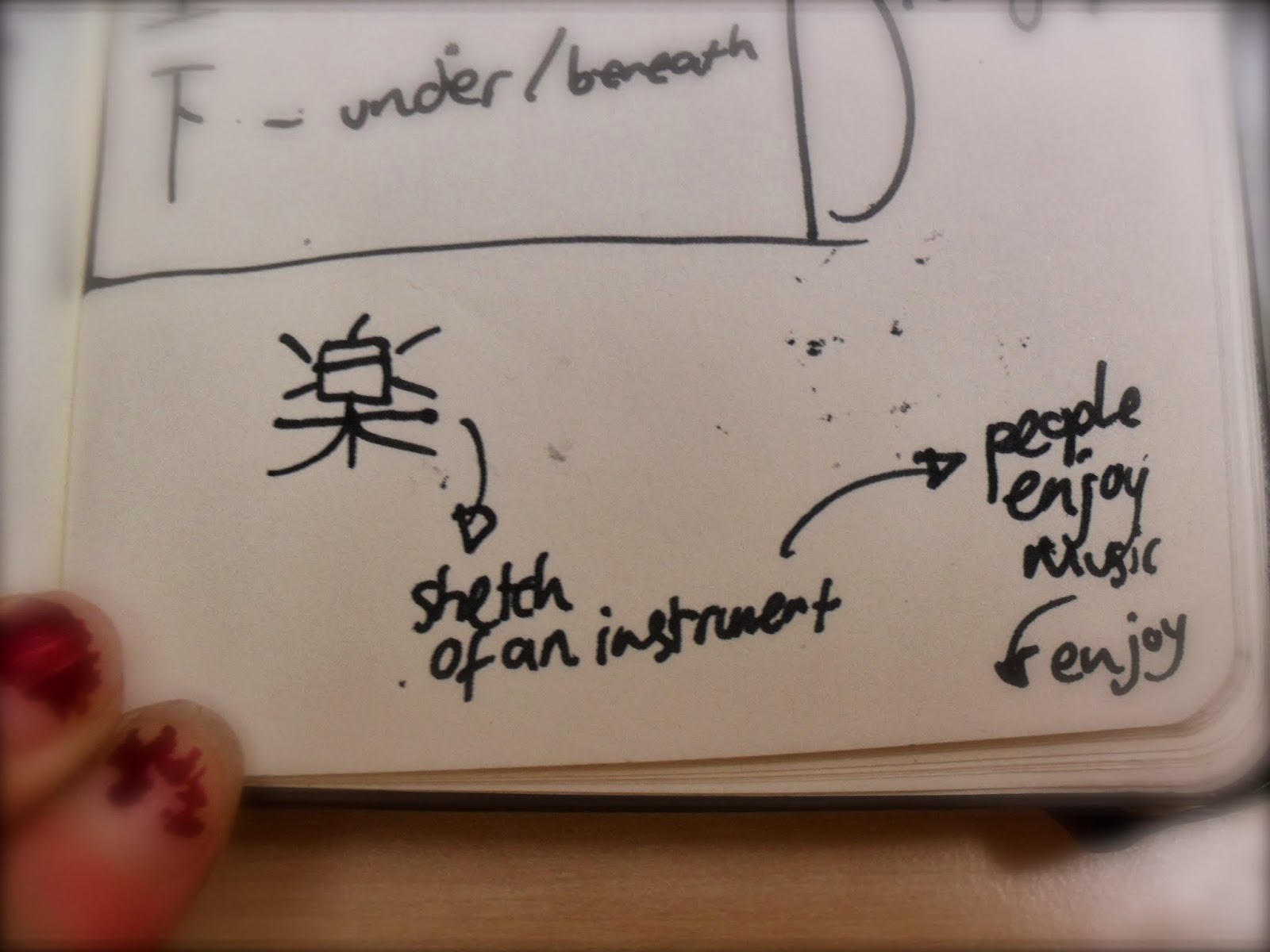


The above character means "to enjoy" however, because there isn't a pictorial representation of that, we have here in stead an abstracted version of a sketch of a musical instrument, and because people enjoy music, this symbol therefore can be derived to mean "enjoy. 

I personally find Kanji fascinating, as not only are there hundreds and thousands of characters with different symbolic qualities, but even more combinations of characters to be learned. 

Thursday, 3 October 2013

3/10/13- My First Post (The Summer Project)

The Title Page for my project
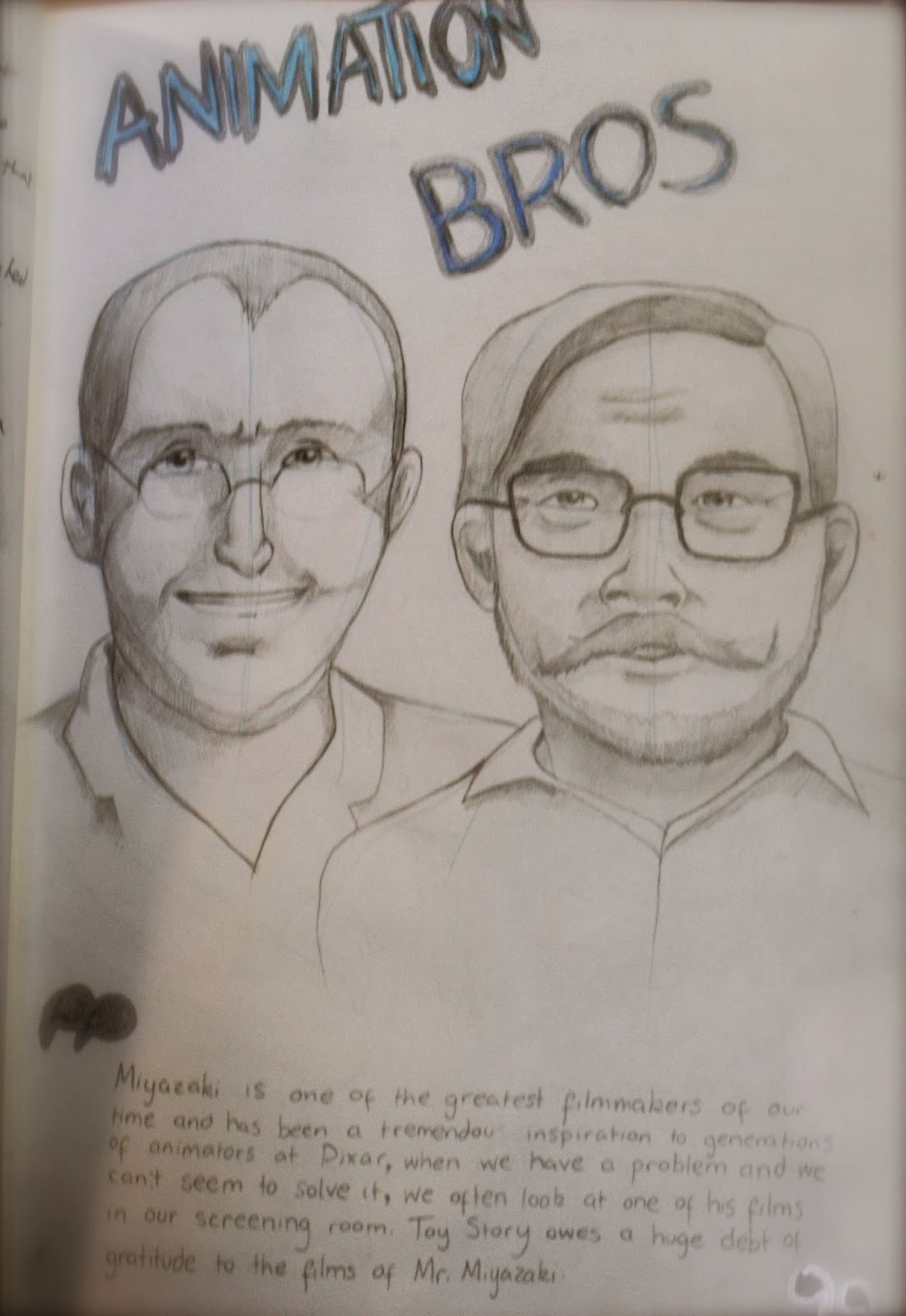
Over the Summer, we were given the task of completing a sketchbook on the subject of a person or movement in our individual fields and their influence on those fields, mine being animation. I based my sketchbook on Hayao Miyazaki and the animation studio he co-founded, Studio Ghibli.
I have always been exposed to animated films, ever since I was a baby, but I only really first considered animation as a future career after the first time I saw one of Miyazaki's most critically acclaimed films, 'Spirited Away', when I was 13. After that, all I wanted to be was an animator, and because of this inspiration I feel very passionately about Miyazaki's work, so it was only natural for me to base the project on him.
I wanted my sketchbook to have a good balance between visual and written material, so I illustrated a lot of it, including copies of characters from the films, as well as my own original sketches inspired by the Ghibli style. Meanwhile, the writing side of my project was fairly structured, including a short biography of Hayao Miyazaki, his filmography, the ideas and themes of his films, Studio Ghibli's effect on the rest of the animation world, as well as the creation process.
Due to the fact I have already researched Studio Ghibli and Hayao Miyazaki prior to the announcement of the project, I already had some good basic information and understanding to work with, although a lot of my research was made using the web and various Studio Ghibli Art Books.
One of my main focuses was the relationship between Studio Ghibli and Pixar Studios, which is especially interesting due to the big difference between the animation styles and techniques. 
I thoroughly enjoyed this project- I got to fully immerse myself in a subject I felt very strongly about, as well as develop my own drawing skills while I was away from college.